YouControl People
Individual verification tool
YouControl API — YouScore
Automation of compliance business processes and data entry for counterparts
YC Markets
Search for new partners, clients, and analysis of various business sectors in Ukraine and the United Kingdom
YC World
Search and verification of connections with public figures and individuals from sanction lists
YC Academy
Free online courses on business intelligence and compliance
Financial scoring of Ukrainian banks
Reliability scoring index
Creating a company for a certain agreement only or with the intention to siphon off the illegally earned money is, unfortunately, a common situation in our society. And although the state and responsible business make efforts to fight this disaster, the problem has not been completely overcome yet. In order not to sort out the negative consequences of interacting with shams, you should arm yourself with knowledge of how to recognise an unreliable counterparty in advance. Sergi Milman, the founder and CEO of YouControl, told "NV.Business" about the signs of shell companies.
According to resolution №58 of the board of the National Bank of Ukraine, a shell company is a non-resident legal entity that does not carry out the actual economic activity in the country of its registration or whose ownership structure does not allow to determine its real ultimate beneficial owners. Simply put, it is a company that exists and operates only on paper.
Such a fictitious company is often created to participate in money laundering schemes, concealment of corruption related and other crimes and tax evasion. The term of "life" of most such companies is a year or even less. It was created, then it committed fraud and closed.
The fact that the profile of a company falls under risk criteria may indicate that it is a shell company and does not carry out the real economic activity. These risks are described in detail in the new law on financial monitoring and in the relevant provisions on conducting financial monitoring. The risk criteria are divided into four groups: by the type of a customer, by geography, by the type of a service (a product), by the channel of the supply of a service (a product). Each of these groups has a number of features by which a company is checked for fictitiousness.
Here we will provide a few clearest signs of risks indicating that you are facing a shell company. Let us illustrate them with the real examples found due to the YouControl system.
If the participant, the executive and the chief accountant are one and the same person.
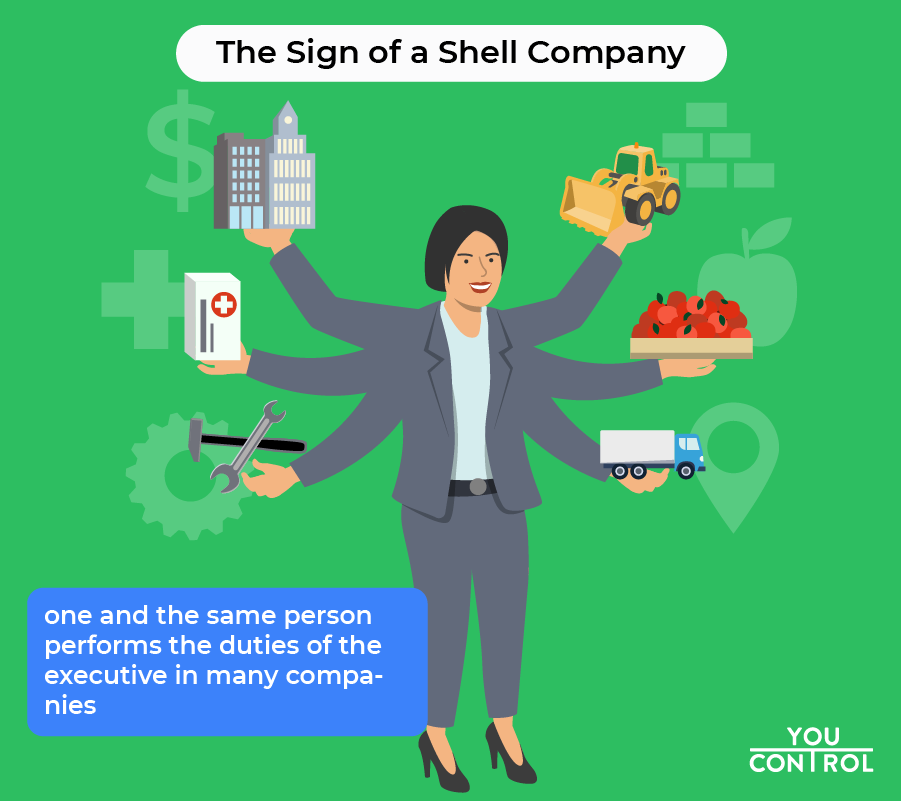
If one and the same person performs the duties of the executive in many companies. Formally, this person cannot perform his/her functions, however legally s/he is listed in dozens of companies. That is, this person is probably a straw person, and the activities of the companies managed by him/her are fictitious. For example, Polishchuk Liubov Mykolaivna successfully runs 21 companies with different profiles: from construction to food wholesale; without leaving her apartment in Obukhiv.
A company operates at the address of mass registration. This is when a company is registered at the premises where 50+ other business entities are registered. Of course, we are not talking about large business centres that are specifically designed for this purpose. We mean, for example, a room in a dormitory, apartment, dwelling house or at other premises where so many companies and their employees cannot be located.
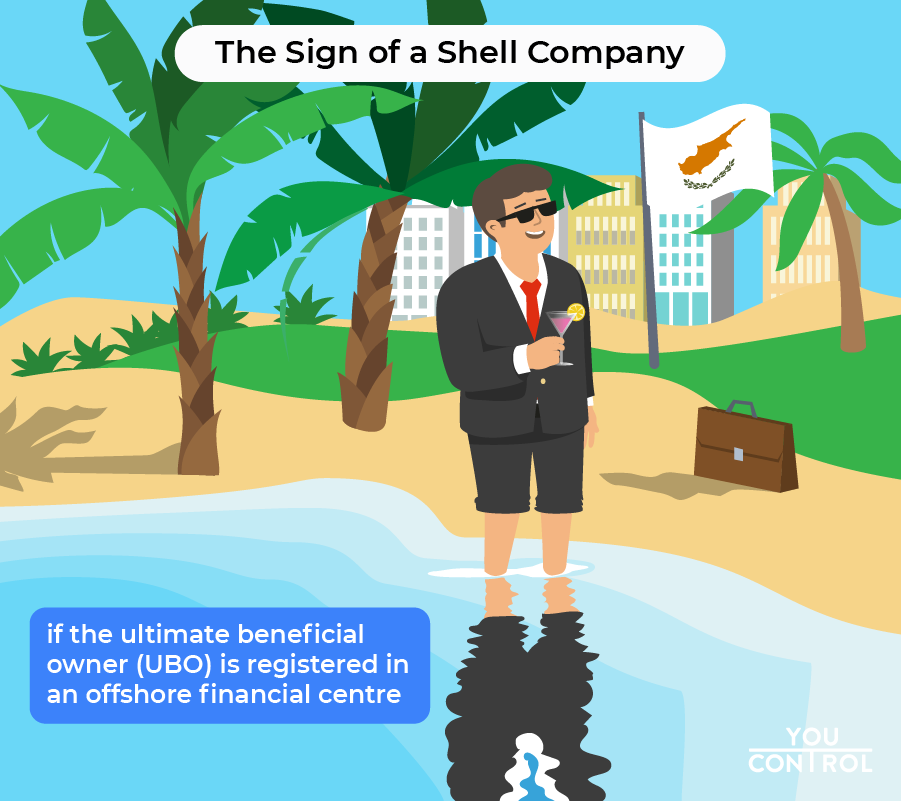
If the ultimate beneficial owner (UBO) is registered in an offshore financial centre or in the country whose legislation provides for a nominal/trust ownership mechanism. For example, LLC "Ozirnianskyi kombikormovyi zavod" has the UBO in Cyprus, although 100 percent of the shares belong to another Ukrainian company, which, by the way, also has the UBO in Cyprus.
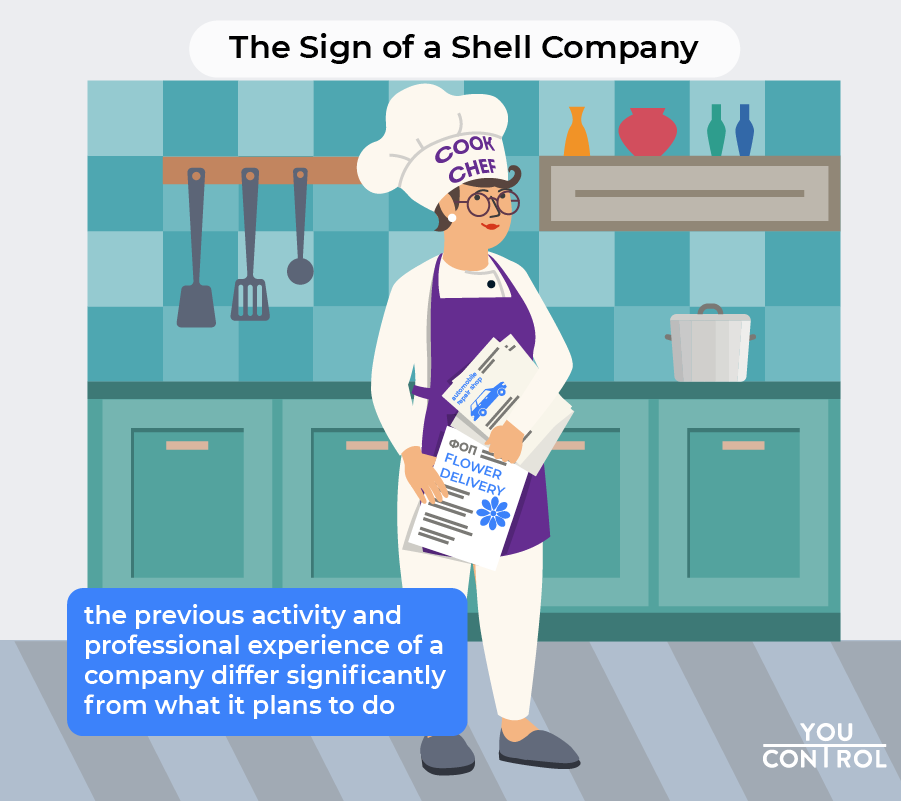
The previous activity and professional experience of a company differ significantly from what it plans to do. Let us say, an organisation whose main type of activity was the manufacture of bread is unlikely to offer services for the sale of securities. For example, LLC "Universal Logistics Solutions" is so universal that it is able to carry out economic activities according to 160 KVEDs (classifier of types of economic activity/NACE), simultaneously providing services of translation, flower delivery, housing rental, car repair, as well as trading in a variety of goods: from computers and medical equipment to clothes and food.
Read more. What Do Frequent Changes in the Work of a Company Indicate
If a company, powerful at first glance, has a small number of employees and at the same time does not submit financial statements to the fiscal or statistical authorities.
The financial transactions of a company are complex, unusually large for its activity or do not correspond to the financial condition. If the financial transactions are conducted in an unusual way or do not have an obvious economic or legal purpose.
Lack of production capacities, trade and warehouse premises. This is when an enterprise does not have the assets to implement cooperation. For example, LLC "Agrochemproduct" will easily offer you the supply of mineral fertilizers at a very beneficial price, although it has had neither real estate nor vehicles for all 13 years of its existence.

If the executive of a company is a person belonging to socially vulnerable groups (a mother on maternity leave, a pensioner aged over 75, a student aged under 20), and the company management, ultimate beneficial owners and its name often change.
In the case when almost all profit of a company consists of participation in government tenders.
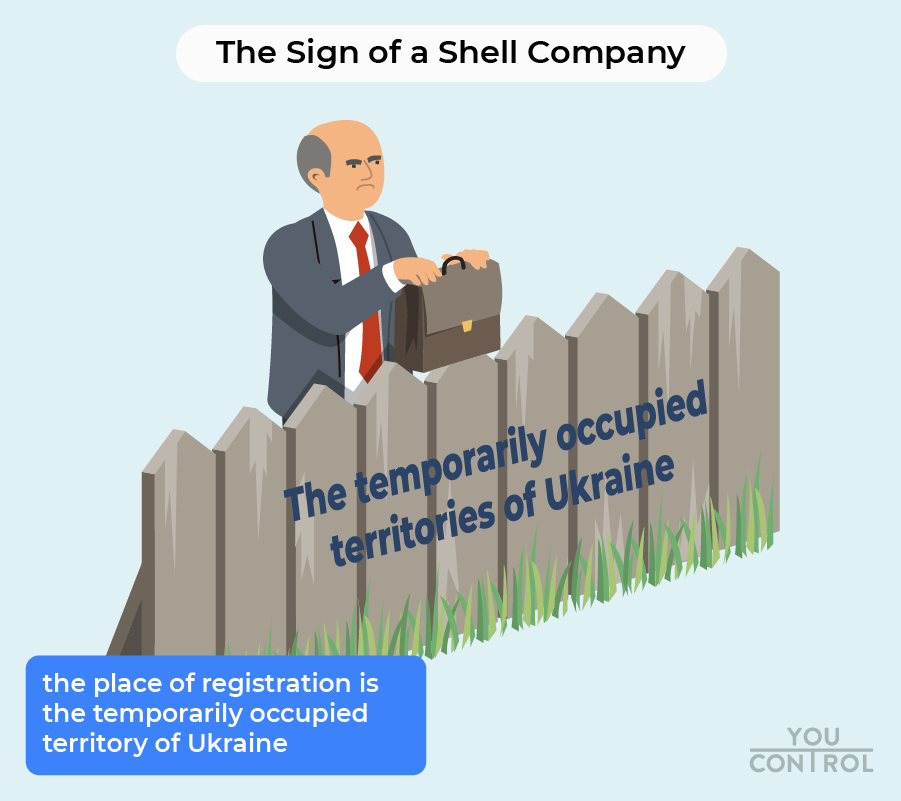
The place of registration is the temporarily occupied territory of Ukraine. For example, LLC "Patison" is still not in the state of termination, although it is not only registered on the occupied territory but also is subject to sanctions.
A company uses promissory notes or barter agreements for settlements, attracts significant long-term borrowings (except for bonds) from the individuals or companies that do not belong to its ownership structure.
A company conducts suspicious activities: gambling, lotteries, collection services, trade in real estate, luxury goods, antiques, works of art, precious metals and stones; manufacture and/or trade in weapons, ammunition, military equipment and military vehicles; foreign exchange intermediary services, etc.
These are far from all signs of shell companies. And the detection, based on the analysis, of one or more striking features in a counterparty does not mean that its activity is fictitious. However this suggests that before making a final decision on cooperation, you should be especially careful about the case and analyse the risks in their interrelation. We hope that the requirements of the new Law on Financial Monitoring №361-IX will contribute to the reduction of the number of fictitious companies and to the creation of a transparent business environment in general.
Читайте також:
News 9 April 2021
Data on Fines from the Antimonopoly Committee of Ukraine Are Now in the Express Analysis
The Express Analysis from YouControl now shows fines from the Antimonopoly Committee of Ukraine (AMCU) for violating the rules of economic competition. Previously such information had to be sought in the official public announcements of the AMCU, now it can be checked in YouControl in 30 seconds. The tool will be useful to automate the process of checking a counterparty during tenders.
Аrticles 25 March 2021
Risks of Cooperation with Counterparties from Countries with a High Level of Corruption
The location of participants or beneficiaries of a company in the so-called risky jurisdictions attracts special attention of the National Bank of Ukraine (NBU) within financial monitoring. We devoted a separate article to this factor. You will find the whole series of articles on risk factors and the provisions of the Law on Financial Monitoring at the end of this article. The Corruption Perceptions Index is a global ranking of countries concerning their corrupt practices.
Аrticles 19 March 2021
Risks of Cooperation with Tax Evaders
Debts to the Tax Service are one of the risk factors according to the National Bank of Ukraine (NBU). The Express Analysis from YouControl draws your attention to this factor while checking a counterparty and works out if a company has a tax debt for the last available period. We are explaining what this means and why you need to be especially careful while working with such a counterparty. A tax debt is the amount of monetary obligation not paid by a taxpayer in a timely manner.

YouScore
API for Automated Counterparty Verification
YC.Market
Search for Clients, Partners, and Suppliers
YC World
International Connection Search, Mapping, and Visualization
YC Academy
International Compliance Officers Community
Expert Opinion
Written Report on a Company or Sole Proprietor
Extension
Firefox, Google Chrome
YouScore
API for Automated Counterparty Verification
YC.Market
Search for Clients, Partners, and Suppliers
YC World
International Connection Search, Mapping, and Visualization
YC Academy
International Compliance Officers Community
Expert Opinion
Written Report on a Company or Sole Proprietor
Extension
Firefox, Google Chrome

 -> ‘Add to Home Screen’