YouControl People
Individual verification tool
YouControl API — YouScore
Automation of compliance business processes and data entry for counterparts
YC Markets
Search for new partners, clients, and analysis of various business sectors in Ukraine and the United Kingdom
YC World
Search and verification of connections with public figures and individuals from sanction lists
YC Academy
Free online courses on business intelligence and compliance
Financial scoring of Ukrainian banks
Reliability scoring index
YouControl’s R&D Centre has assessed the pace of foreign companies withdrawal from the russian federation broken down by countries and economic sectors. They have identified leaders and outsiders in the process of economic pressure on the aggressor country. More details in our new exploration.
📌Takeaways:
voluntary corporate sanctions are an essential instrument for scaling the official sanction pressure;
the top 5 business boycotting countries are Australia, Norway, Lithuania, the UK, and South Korea;
Turkey and China are the absolute leaders in the portion of corporations that are unsupportive of the voluntary sanctions idea.
the most significant amount of companies loyal to russia operate in the following areas: healthcare, production of stock and raw materials for metallurgy, construction, telecom, and textile industry.
Yale School of Management study claims that as of 9 May 2022, almost 1,000 companies have announced their curtailment of operations in russia to some degree beyond the bare minimum legally required by official international sanctions. This business boycotting movement is called voluntary or indirect sanctions. They complement and strengthen the official sanctions packages geared to the economic deterrence of the aggressor.
Economic pressure is exerted through shortfalls in export earnings, disruptions in the process supply chains for critical imports, tax gaps, and collective redundancies. Thus, at least 200,000 foreign company staff can lose their jobs in Moscow.
Voluntary corporate sanctions are an essential instrument for scaling official sanction pressure by businesses in the countries whose governments are currently neutral. A graphic example is Indian company Tata Steel shunning russian coal “as transactions with Russian suppliers and bankers come with a lot of uncertainties due to international sanctions imposed on Russia.”
The countermeasures the aggressor’s government has adopted for nationalization speak for the effectiveness of the ethical conduct pursued by foreign companies set to withdraw from russia.
However, the business boycotting of russia, does not come without problems: by no means all foreign companies have shown social responsibility. Many companies have continued to operate in russia undeterred. And the measures announced publicly by some corporations sometimes look like a perforce tribute to PR protection.
To quantify the rate of businesses withdrawal from russia, YouControl has developed a unique integral ELI index (Exodus Level Index). It aggregates information on the quantity distribution of companies from this country by 5 categories of corporate response to the russia-Ukraine war. The index was based on the Yale University researchers’ recommendations for the foreign companies classification.
ELI index criteria:
withdrawal: companies halt operations or have exited the russian market (5 points on a 5-point scale);
suspension: suspend operations while keeping options open for return (4 points);
scaling back: reduce only some operational processes (3 points);
buying time: continue to operate but do not invest in development (2 points);
digging in: continue to work in russia without restrictions (1 point).
The minimum index of 1 (red) is assigned to a country where all companies remain in russia. Whereas the maximum index of 5 (green) means that all companies in a country have decided to leave the russian market. In reality, each country has companies with different reaction levels to the russia-Ukraine war, so the business boycotting index depends on the company category predominating among members of a particular jurisdiction.
The sanction pressure on russia varies substantially in different countries: the UK, the United States, Poland, and the Baltic States demonstrate practical support to Ukraine. Instead, the largest Asian, African, and Latin American countries have assumed a neutral posture as observers. Similar trends are observed in the field of voluntary sanctions. The level of corporate boycotting of the russian market depends significantly on the geography of the location of multinational companies’ head offices.

As of 9 May 2022. Source: Yale CELI; computation: YouControl
The top 5 business boycotting countries are:
Australia (ELI = 4.5);
Norway (ELI = 4.4);
Lithuania (ELI = 4.3);
UK (ELI = 4.3);
South Korea (ELI = 4.2).
Many foreign companies in Canada, Sweden, Ireland, Finland, and Poland have withdrawn from the Russian market or ceased operations there (ELI > 4). Among the business boycotting leaders are those very countries that provide considerable amounts of military aid and are the most supportive of the sanction pressure on the global stage.
The Nordic Countries’ businesses showed massive support to the voluntary sanctions idea in contrast to the Southern European ones, which were more loyal to russia. In particular, reaction to calls for exit from russia among Spanish, Portuguese, French, and Italian brands was quite ambiguous and divergent.
The slowest pace of exit and high portion of companies that keep their business-as-usual in russia among European countries is observed in Iceland, Slovenia, Greece, Austria, and Hungary.
The top 5 countries with the lowest level of businesses withdrawal from russia:
Turkey (ELI = 1);
China (ELI = 1.5);
Iceland (ELI = 1.7);
Slovenia (ELI = 1.8);
Greece (ELI = 1.8).
Turkey and China, and such Asian countries as India, Israel, and the United Arab Emirates, are the absolute leaders in the portion of corporations that are unsupportive of the voluntary sanctions idea. Although, companies in these countries have suspended operations in russia, especially players in the financial and technology sectors.
Companies in the services sector (namely: business services, sport, media, and finance), as well as high-tech industries, are more likely to leave the russian market. Less than 12% of the investigated foreign companies in these industries firmly refused to leave the russian market, while more than 50% announced their withdrawal or suspension of operations. For example, 164 out of 209 high-tech foreign companies have completely exited or suspended operations in russia. 22 have continued as usual, and 23 have continued with certain restrictions on operations and investments.

As of 9 May 2022. Source: Yale CELI; computation: YouControl
The most significant portion of companies loyal to russia appears in such economic sectors as healthcare, materials including metals, construction, telecom, and apparel. Staggered trends of attitude towards russia are observed among foreign companies in the energy industry (in particular oil and gas business), industrials, transportation, food, beverages & tobacco, and chemical industry.
The top 5 sectors with the highest business boycotting level:
sports (ELI = 4.6);
business services (ELI = 4.4);
media (ELI = 4.1);
retailing (ELI = 4.0);
technology (ELI = 3.8).
The top 5 economic sectors with the lowest level of foreign companies exit from russia:
healthcare (ELI = 2.0);
materials, in particular, metallurgy (ELI = 2.8);
energy, oil, gas (ELI = 2.8);
apparel (ELI = 3.0);
industrials (ELI = 3.0).
Foreign companies' sectors breakdown in business boycotting leads to unhappy conclusions. After all, export earnings in the base material sectors of the economy come from the sales of gas, oil, petroleum, and metallurgy products that underpin the aggressor's economic potential and finance the army, which poses a threat to the world order. Despite the partial exit of 30 to 50% of foreign companies from these sectors, an equal portion of companies is not in a hurry to leave the market and stop collaborating.
YouControl is closely watching the process of a multinational company's exit from the russian market. We pay special attention to the businesses that have continued to operate, supply products, and fill the aggressor's state budget with taxes.
Unfortunately, some of these companies have subsidiaries in Ukraine. You can quickly check for such toxic connections with foreign collaborating companies using YouControl's Express Analysis module. The new factor "The company is a member of a joint holding with a counterparty which operates under the russian federation jurisdiction" shows that Ukrainian subsidiaries are bound to foreign parent holdings which have decided to continue cooperation with russia.
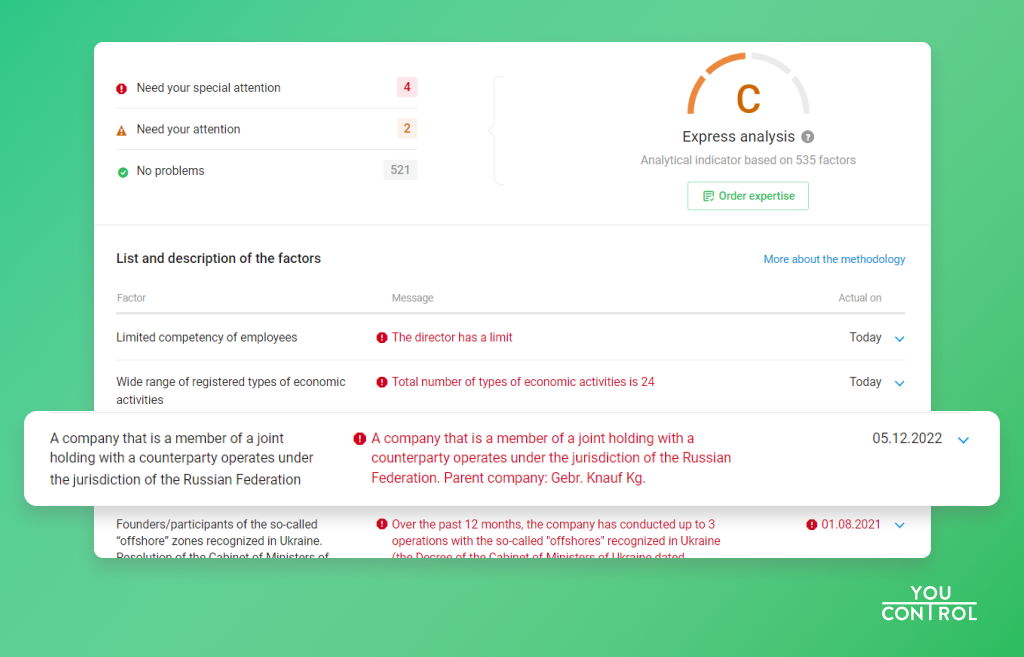
It is a reminder that in addition to this factor, YouControl Express Analysis enables you to identify links to the sanctioned entities and persons and Ukrainian companies’ affiliation with russia and belarus.
Incessant media, public and sanction pressure, and constant maintenance of interest in further actions by the companies linked to russia through operations and beneficiaries are essential prerequisites for success on the economic front and facilitation of Ukraine’s victory.
Читайте також:
News 9 April 2021
Data on Fines from the Antimonopoly Committee of Ukraine Are Now in the Express Analysis
The Express Analysis from YouControl now shows fines from the Antimonopoly Committee of Ukraine (AMCU) for violating the rules of economic competition. Previously such information had to be sought in the official public announcements of the AMCU, now it can be checked in YouControl in 30 seconds. The tool will be useful to automate the process of checking a counterparty during tenders.
Аrticles 25 March 2021
Risks of Cooperation with Counterparties from Countries with a High Level of Corruption
The location of participants or beneficiaries of a company in the so-called risky jurisdictions attracts special attention of the National Bank of Ukraine (NBU) within financial monitoring. We devoted a separate article to this factor. You will find the whole series of articles on risk factors and the provisions of the Law on Financial Monitoring at the end of this article. The Corruption Perceptions Index is a global ranking of countries concerning their corrupt practices.
Аrticles 19 March 2021
Risks of Cooperation with Tax Evaders
Debts to the Tax Service are one of the risk factors according to the National Bank of Ukraine (NBU). The Express Analysis from YouControl draws your attention to this factor while checking a counterparty and works out if a company has a tax debt for the last available period. We are explaining what this means and why you need to be especially careful while working with such a counterparty. A tax debt is the amount of monetary obligation not paid by a taxpayer in a timely manner.

YouScore
API for Automated Counterparty Verification
YC.Market
Search for Clients, Partners, and Suppliers
YC World
International Connection Search, Mapping, and Visualization
YC Academy
International Compliance Officers Community
Expert Opinion
Written Report on a Company or Sole Proprietor
Extension
Firefox, Google Chrome
YouScore
API for Automated Counterparty Verification
YC.Market
Search for Clients, Partners, and Suppliers
YC World
International Connection Search, Mapping, and Visualization
YC Academy
International Compliance Officers Community
Expert Opinion
Written Report on a Company or Sole Proprietor
Extension
Firefox, Google Chrome

 -> ‘Add to Home Screen’