YouControl People
Individual verification tool
YouControl API — YouScore
Automation of compliance business processes and data entry for counterparts
YC Markets
Search for new partners, clients, and analysis of various business sectors in Ukraine and the United Kingdom
YC World
Search and verification of connections with public figures and individuals from sanction lists
YC Academy
Free online courses on business intelligence and compliance
Financial scoring of Ukrainian banks
Reliability scoring index

Financial scoring
This is a system of measuring a company’s financial sustainability by translating the calculated financial indicators into scores. YouControl’s financial scoring results in a composite index called FinScore.
FinScore is a score index that measures a company’s financial sustainability, calculated by YouControl analysts. It is based on 20 financial indicators that provide a comprehensive description of the company’s liquidity, solvency, profitability and business activity.
Combining modern machine learning, neural networks, logistic regression modeling and financial analysis methods, the FinScore index for years has proved its high alarm capacity to predict the probability of companies’ bankruptcy.
FinScore index values vary from 1 (minimum financial sustainability) to 4 (maximum financial sustainability), depending on the values of the company’s financial indicators.
Components of this index have been thoroughly selected based on the results of empirical analysis of trends of about a hundred conventional financial indicators. Risk indicators used in calculating this index and scoring algorithms demonstrate maximum predictive ability to assess a company's financial condition.
That means that Ukrainian companies with poorer values of these indicators more often went bankrupt than their competitors during the analysed period of 2011 to 2020.
Combining expertise in economic theory, financial analysis and machine learning technology, YouControl's R&D team has built a new scoring model which generates integrated financial sustainability index FinScore with enhanced accuracy of bankruptcy probability estimation. In the updated FinScore index computation model, starting from 2019, companies with the index ‘D’ tend to go bankrupt 10-14 times more often than companies with the index ‘A’ (depending on the selected back-testing period).
Unlike the previous scoring algorithm, the new method does not provide for sectoral differentiation of companies, linear relationships or translation of financial indicators into intermediate points to compute total scoring value. The input factors for the model are the company's conventional financial indicators, pre-selected according to the level of historical ability to predict Ukrainian companies’ bankruptcies. The selected indicators comprehensively reflect a company’s financial condition in terms of its liquidity, solvency, profitability and business activity.
Previously, the FinScore computation formula was linear for each financial indicator. In the absence of any of them, the financial sustainability index was not computed. The new model solves this problem, as it is not linear and is based on the machine learning algorithm which determines bankruptcy probability from all data available.
At the model’s factors selection stage, correlations between companies’ financial sustainability and previous distribution of each indicator were tested, using paired logistic regressions and graphical retrospective analysis over the previous ten-year period.
The values of each of the indicators which were previously included in the FinScore index were automatically translated into 1 to 4 scores depending on their rank against empirical quartiles of a set of values of a respective indicator for the rest of the companies in the market. Where the value of a company’s indicator tended towards the maximum positive value in terms of financial sustainability, the company got 4 for this indicator. Companies with poorer values got lower scores.
Empirical quartiles of a set of values of the net profit margin (NPM) indicator for the analysed year and a respective sector of economy were [0%, 1%, 5%]. So the score for this indicator for the companies in the sector was calculated in the following manner:
Where the company had very high net profit margin (NPM > 5%) it got 4 scores.
In case 1 < NPM < 5% the company got 3 scores.
In case 0 < NPM < 1% the company got 2 scores.
In case NPM < 0% the company got only 1 score.
Scores for the rest of the indicators included in the FinScore index can be calculated in a similar manner.
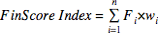
Fi
– score for the factor expressed as indicator i. Constraint:

Wi
– weight of factor
Fi
— Constraint:
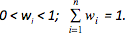
n – number of index indicators. n= 10.
For companies for which it is not possible to compute the full list of component indicators, the FinScore index is not computed. Values of some of the available components can be found on the YouControl website at any time.
Each numeric value of FinScore (4 to 1) corresponds to a particular letter of the alphabet which describes the relative level of financial sustainability in a particular market.
High level of financial sustainability
(Above the upper FinScore quartile)
Good level of financial sustainability
(Above the FinScore median)
Satisfactory level of financial sustainability
(Above the lower FinScore quartile)
Unsatisfactory level of financial sustainability
(Below the lower FinScore quartile)
Each numeric value of FinScore (4 to 1) corresponds to a particular letter of the alphabet which describes the relative level of financial sustainability in a particular market.
Efficiency of the financial scoring model suggested by YouControl analysts has been proved by the history of Ukrainian companies' bankruptcies.
Thus, the companies that went bankrupt had demonstrated average lower values of the index compared to the surviving companies. Decrease of this index also signals about potential degradation of financial sustainability.
As demonstrated by the history of Ukrainian companies’ defaults between 2015 and 2020, yearly 55-61% of firms from among the bankrupt companies had been in the FinScore group ‘D’ while mere 3-5% of companies had been in group ‘A’.

The companies that have gone bankrupt in 2021 were demonstrating decrease in the FinScore index during the last 10 years (Diagram 1) unlike the going concerns, whose FinScore median was staying the same (Diagram 2).
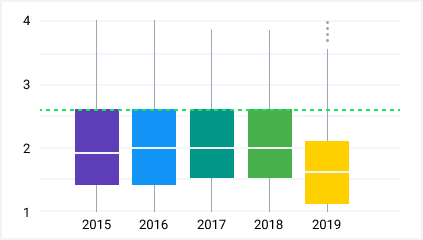
DIAGRAM 1. FINSCORE INDEX OF BANKRUPT COMPANIES
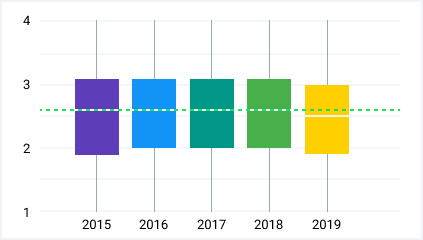
DIAGRAM 2. FINSCORE INDEX OF SURVIVED COMPANIES
The purpose of FinScore computation is quick analysis of the level of a company’s financial risks. Based on the analysis results, users can swiftly decide whether any further research of the counterparty firm is needed.
Please note that this index cannot qualify as a credit rating because the latter requires deeper expert analysis and additional consideration of several qualitative factors, in particular the level of outside support, shareholders’ reputation and other operational and legal risks.
The FinScore index has a probabilistic nature, that’s why even maximum values of this index never guarantee 100% financial sustainability but only suggest that the probability of bankruptcy for the company is relatively lower. This is an information product that reflects YouControl’s vision of the general level of financial risks. It is the user who is to draw final conclusions on the company’s financial sustainability, taking into account other qualitative factors and additional sources of information.

YouScore
API for Automated Counterparty Verification
YC.Market
Search for Clients, Partners, and Suppliers
YC World
International Connection Search, Mapping, and Visualization
YC Academy
International Compliance Officers Community
Expert Opinion
Written Report on a Company or Sole Proprietor
Extension
Firefox, Google Chrome
YouScore
API for Automated Counterparty Verification
YC.Market
Search for Clients, Partners, and Suppliers
YC World
International Connection Search, Mapping, and Visualization
YC Academy
International Compliance Officers Community
Expert Opinion
Written Report on a Company or Sole Proprietor
Extension
Firefox, Google Chrome

 -> ‘Add to Home Screen’